
1. Introduction
These Tonga National Qualifications and Accreditation Board Guidelines for the Registration of Post Compulsory Education and Training (PCET) Providers detail the procedures involved. The Guidelines should be read in conjunction with the current versions of the TNQAB quality assurance policies manual and the Tonga Qualifications Framework manual.
Each Provider’s application for registration is evaluated against the five elements of Accreditation Standard 1, as specified in Schedule C of Tonga National Qualifications and Accreditation Board Regulations 2008.
2. Overview of Procedure
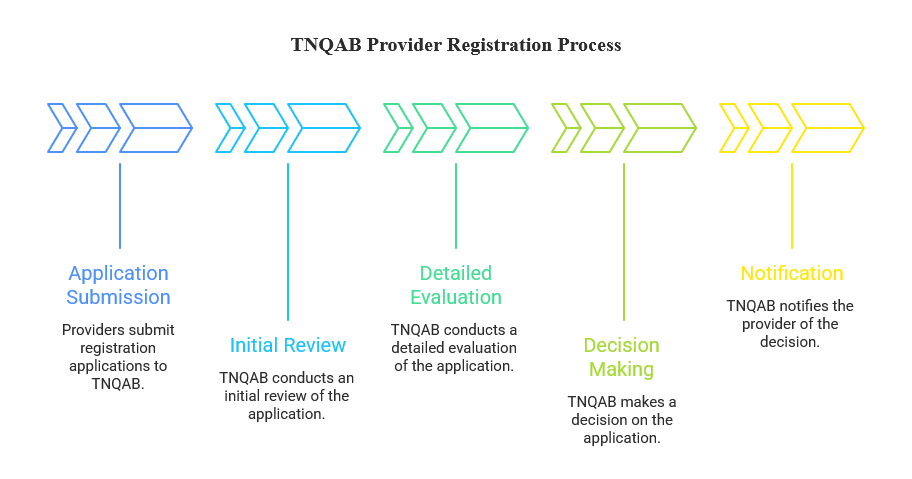
The following flowchart summarises the process that TNQAB (“the Board”) follows when evaluating provider registration applications
3. Applications
Each application for provider registration should consist of a copy of each of the following:
3.1 A completed Registration Application Form (see Application form – Appendix 1a 1b & Appendix 2).
3.2 A completed Provider Registration Checklist (see Application form – Appendix 3), with references to evidence that demonstrates how the Provider/Organization meets each of the elements of TNQAB Accreditation Standard 1.
3.3 Specific documentation referenced in the above; including the Provider’s/ Organization’s Quality Management System QMS ; and
3.4 Payment of the approved fee – TOP500.00 + GST
4. Evaluation Procedure
4.1. Prior to submitting the application, the Provider/Organisation may seek advice from TNQAB on any matter concerning the criteria for provider registration and on the procedure to be used by the Board to evaluate the Provider/Organisation’s application.
4.2. The application is received, logged and acknowledged by a TNQAB officer.
4.3. It is then checked by a Quality Assurance (QA) Officer for completeness, and additional information is requested when necessary.
4.4. The responsible QA Officer carries out a preliminary evaluation against each element of Accreditation Standard 1 and records their comments on a copy of the Provider Registration Checklist (see Appendix B).
4.5. The QA Officer visits the Provider/Organisation on an agreed date in order to meet with the Head or equivalent and senior staff, and to verify the documentary evidence.
4.6. After the visit, the QA Officer compiles a draft report summarising the findings against each element of Accreditation Standard 1 and making appropriate recommendations to the Board.
4.7. The draft report recommends that the Board either:
- Approve registration as a PCET Provider; or
- Approve provisional registration as a PCET Provider, specifying one or more minor operational issues that must be addressed by the Provider within an agreed timeframe; or
- Decline registration, specifying the issues that must be addressed by the Provider before the application will be reconsidered.
4. 8 The QA Officer submits the draft report to the CEO TNQAB who considers the report and makes any necessary amendments prior to submitting it to the Board.
4.9. The Board considers the draft report, requests further information from the QA Officer via the CEO if necessary and then decides with regard to the recommendations.
4.10. The CEO, as Secretary to the Board, sends a letter notifying the Provider/Organisation of the Board’s decision, enclosing a copy of the approved final report and the Provider’s Certificate of Registration, where appropriate.
4.11. If the Board’s decision is not to register the Provider/Organisation, the latter can resubmit the application to TNQAB as soon as the issues in question have been addressed satisfactorily. The QA Officer will then write and submit a supplementary report to the CEO, who will submit it to the Board.
4.12. Provider registrations are subject to the following conditions:
- That the Provider will at all times comply with the relevant policies and criteria established by the TNQAB that are currently in force.
- That the Provider will promptly inform Board of any changes to its governing body, name, physical address, contact details or educational and training purpose; and That the Provider will pay the annual registration fee set by the Board.
5. Application Fees and Annual Registration Fees
5.1 New application for Registration will pay an establishment fee of TOP500 + GST.
5.2 TNQAB charges providers an annual fee consisting of a base fee of TOP200 + GST plus an additional $10 for every full-time equivalent (FTE) student enrolled in the previous 12-month period from 1 January to 31 December.
Student full-time equivalent are calculated on the basis that a student studying on a full-time programme for one year is 1full time equivalent. Full time equivalent for part-year and part-time students will be calculated based on the previous year (2 semesters) using the same formula that Ministry of Education uses to determine the head count funding provision.
An annual fee covers work undertaken by the Quality Assurance Division (QAD) of TNQAB that benefits the whole sector and cannot be charged at an hourly rate to individual providers. This includes work associated with:
- ongoing advice, guidance and ongoing monitoring of providers
- database maintenance
- development of operational policy and procedures
- risk management
- complaints work
- legal work
- Publications, and work with other agencies and the TNQAB.
Private and Government providers who are registered with TNQAB must pay the annual registration fees which are due no later than 31 March each year. A notice of non-compliance will be sent to providers who fail to settle the annual fees after one month from the due date.
5.3 Where specialists need to be used from overseas in the evaluation of provider registration, they shall be paid at an equivalent rate to that paid for equivalent work in their respective countries.
| Accreditation Standard 1 Element | Evidence and Requirements |
|---|---|
| 1.1 The provider or its governing body is a legally established or recognised enduring body |
|
| 1.2 The provider has measurable goals and objectives for education and training |
1. The applicant should supply:
|
| 1.3 The provider has a coherent, documented quality management system (QMS) of policies and procedures. |
1. The applicant should provide:
2. The applicant should provide:
3. The applicant should provide:
4. The applicant should supply:
5. The applicant should provide:
6. The applicant should provide:
7. The applicant should provide:
8. The applicant should provide:
9. The applicant should provide:
10. The applicant should provide:
11. Applicant should provide:
12. Applicant should provide:
|
| 1.4 The provider has adequate and appropriate governance and management to achieve its goals and objectives |
1. The applicant should supply:
2. The applicant should provide:
3. Applicant should provide:
4. The applicant should provide copies of:
|
| 1.5 The provider’s name is appropriate and does not mislead learners about the nature of the organisation. |
1. Where the PCET provider is not a body corporate, the applicant must provide evidence where the PCET provider’s name is different from its legal name, or the name of the governing body.
2. The PCET provider’s name should not be misleading and should not contain any of the
|